


Unlocking Enterprise Data: How Mirantis k0rdent and Dell PowerStore Deliver the Ultimate Stateful Kubernetes Platform
)
The promise of Kubernetes lies in its ability to manage stateless microservices at scale. However, the true enterprise challenge is running stateful applications—databases, message queues, and persistent storage—with the same agility and reliability. This is where the powerful combination of Mirantis k0rdent and Dell’s family of backend storage (PowerStore, PowerMax, PowerFlex, PowerScale), unified by the Dell Container Storage Interface (CSI) Driver, delivers a production-grade solution. This integration provides the control plane (k0rdent) and the data plane (PowerStore) necessary to run mission-critical workloads anywhere, from the data center to the cloud.
"The Mirantis k0rdent and Dell CSM integration closes the loop on stateful workloads in Kubernetes. We now offer platform teams a single, automated fabric that ensures enterprise data security and performance is consistently delivered, no matter how vast or distributed their cluster fleet becomes. It’s enterprise storage, operating at Kubernetes speed." said Florian Coulombel, Principal Software Engineer
The Multi-Cluster Platform: Centralized Management with k0rdent
k0rdent is a composable Kubernetes management platform that consolidates Kubernetes sprawl and increases resource efficiency. It provides platform engineers with a single, declarative control plane to manage vast fleets of clusters, whether they reside on bare metal, on-prem, in public clouds, or edge locations.
For storage, k0rdent’s value lies in standardizing resource delivery. Instead of manually configuring storage for every cluster, k0rdent enables GitOps-driven automation and uses Service Templates to ensure that every cluster spins up with the required components, including the essential storage connectors, pre-configured. This guarantees consistency and accelerates time-to-value for any new environment.
The Data Pillar: Enterprise Reliability via Dell PowerStore
Dell PowerStore represents the enterprise standard for data storage, offering unparalleled performance, data efficiency, and disaster recovery capabilities. When running stateful applications on Kubernetes, the underlying storage must meet demanding criteria: low latency, high IOPS, and rock-solid reliability.
This is where the Dell CSI Driver becomes the crucial bridge. The CSI standard allows storage vendors to integrate their arrays directly into the Kubernetes control plane.
The Power of the Dell CSI Driver:
Dynamic Provisioning: The CSI driver allows k0rdent and Kubernetes to talk directly to the PowerStore array. When a developer creates a Persistent Volume Claim (PVC) for a database, the CSI driver immediately provisions the required storage capacity directly from the PowerStore array—no manual ticket or human intervention needed.
Performance Tiers: Kubernetes can request storage optimized for different workloads (e.g., highly optimized block storage for databases, file storage for shared content), with the PowerStore intelligently handling the fulfillment.
Data Protection Features: The CSI driver exposes PowerStore’s native functionality, allowing developers and operators to trigger actions like snapshots and volume cloning directly using standard Kubernetes API commands. This integrates enterprise-grade data protection into the cloud-native workflow.
What was Validated:
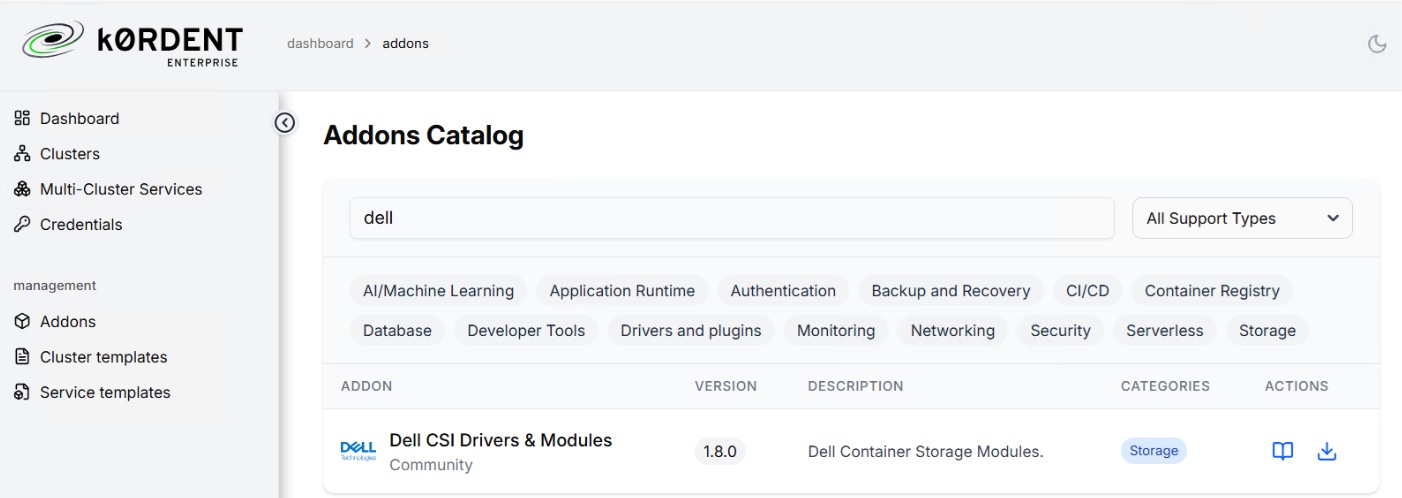
The Dell CSI drivers and Container Storage Modules (CSM) are now available through thek0rdent catalog.
The qualification and default values are ready to go with CSI PowerStore.
Under the hood, we’ve integrated the umbrella Helm chart for Dell Container Storage Modules, enabling installation of the full ecosystem.
We strongly recommend following the official Helm installation documentation to ensure all prerequisites and values are properly configured for your environment.
The Synergy: Production Readiness Without Compromise
The integration between k0rdent and Dell PowerStore creates a single, powerful platform where the control layer respects and leverages the the data layer’s capabilities.
| Feature | k0rdent’s Role | Dell PowerStore + CSI’s Role | Combined Benefit |
| Operational Consistency | Automates the deployment of the Dell CSI Driver and related policies via Service Templates. | Ensures uniform storage configuration across all nodes and clusters. | One-Click Deployments: Every new cluster instantly has enterprise storage capability. |
| Data Resilience | Manages the StatefulSet lifecycle and orchestrates failover between nodes and clusters. | Provides data replication, high-speed snapshots, and guaranteed data integrity. | True HA: Application failures are handled by Kubernetes; data failures are handled by PowerStore. |
| Resource Efficiency | Provides monitoring and observability tools to track workload resource usage. | Provides high-speed, data-efficient storage and intelligent data reduction capabilities. | Maximized ROI: Ensures costly enterprise storage is optimally utilized by Kubernetes. |
| Developer Experience | Provides self-service portals and “golden paths” (IDPs). | Eliminates manual storage provisioning requests; storage is simply consumed. | Accelerated Velocity: Developers get instant access to reliable persistent volumes. |
By combining k0rdent’s streamlined, automated cluster management with the high-performance, resilient data services of Dell PowerStore via the CSI driver, organizations can confidently run their most critical, stateful applications on Kubernetes. This removes the final barrier to achieving enterprise-wide cloud-native transformation.
Ready to unify multi-cluster Kubernetes management with enterprise-grade storage? Check out Mirantis k0rdent Enterprise and Dell Enterprise Storage.
)
)
)


)
)



